Gioacchino Rossini (1792 – 1868) was born in Pesaro, Italy. In view of his background of composing mainly comic operas the few religious compositions of Rossini (Petit Messe Solenelle, Stabat Mater) are sometimes criticized as less serious. Notwithstanding the strong operatic tendencies, especially in the Stabat Mater, this was absolutely not Rossini’s intention. To the contrary, as we can learn from his note to the manuscript of the Petite Messe, he composed these works from a real religious feeling: “Here it is then, this poor little Mass. Have I written truly sacred music, or just damn bad music? I was born for opera buffa, as you well know. Not much skill, but quite a bit of feeling – that’s how I’d sum it up. Blessed be thy name, and grant me a place in Paradise”. At first Rossini composed only sections 1 and 5 through 9 from the intended ten sections of his Stabat Mater. Due to an attack of lumbago, either real or strategic (Rossini was not very motivated, in the beginning), the other sections were composed by Giovanni Tadolini from Bologna. In this form it was played in Madrid in 1832. However, before it could be published Rossini succeeded in getting back the manuscript and re-composed the Tadolini-sections. In 1842 it had its premiere in its definite form. An instrumental parafrase Fantasia su motivi dello Stabat Mater di Rossini was written some years later by Saverio Mercadante.
About the Stabat Mater
Date
1837
Performers
Soprano, alto, tenor, bass, mixed choir and orchestra
Length
CD 1: 61.05 minutes, CD 2: 59.23 minutes, CD 3: 65.03 minutes, CD 4: 59.27 minutes
Particulars
The poet Heine wrote after hearing the Stabat Mater that the theater seemed "a vestibule of heaven". The audiences were deeply moved by the somber beauty of the long opening and taken by the beautiful melodies of the following movements. As evidence of Rossini's serious purpose the work ends with a great double fugue.
Textual variations
The "Analecta"-version of the text is used, with following changes: - Stanza 16, line 2: not "Passionis eius sortem" but "Passionis fac consortem" - After the "Amen" Rossini adds the line "In sempiterna saecula" (In all eternity)
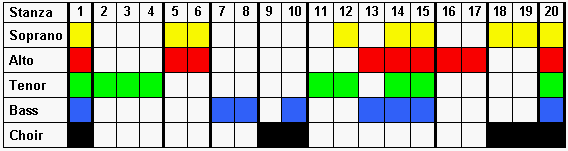
Colour bar
Information about the recording
CD1:
EMI Classics 7243 5 65845 2 (double CD): Stabat Mater – Rossini, Schubert, Vivaldi, Verdi
More info:
Five completely different settings of the Stabat Mater. A "must" for every collector, especially as it has the only performance of Schubert's Stabat Mater D.175. The Rossini Stabat Mater was recorded in November 1982.
Not a commercial CD. This performance and registration origins from an initiative of some Dutch Stabat Mater enthousiasts, who later founded the Stabat Mater Foundation. Recorded at the St.Jan cathedral, 's Hertogenbosch, the Netherlands, in March 1997.
Orchestra:
Orchestre Philharmonia de Paris
Choir:
Choeur Symphonique de Paris
Conductor:
Xavier Ricour
Soloists:
Marie-Paule Dotti, soprano Jaqueline Majeur, mezzo-soprano Patrick Garayt, tenor Christian Nadalet, bass
Code:
1998 ROS 04
CD4:
Stichting Stabat Mater 2008 (cd 10)
More info:
Recorded at the St.Peter church, Oirschot, the Netherlands, in March 2008 published by the Stabat Mater Foundation.
Orchestra:
Het Brabants Orkest
Choir:
Brabant Koor
Conductor:
Louis Buskus
Soloists:
Renate Arends, soprano Barbara Kozelj, mezzo-soprano André Post, tenor Martin Jan Nijhof, bass
Other works:
Daan Manneke, Stabat Mater
Code:
2008 MAN 01
CD5:
APR 5504 Frederic Lamond, The complete Liszt recordings
More info:
Liszt frequently made transcriptions for piano from famous compositions of other composers; one was Rossini's Stabat Mater. Mr. Decker was so kind to provide me with interesting and valueble extra information and thanks to him, I could order this CD with Liszt's piano version of Cuius Animam Gementem.