Luigi Boccherini (1743-1805) was born in Lucca in Tuscany, Italy. He was a master on the cello. He composed more than 250 works of chamber music for strings (trios, quartets, quintets) en is regarded as the “inventor” of the string quintet. In 1768 he moved from Italy to Madrid, where he entered the service of Prince Don Luis, the youngest brother of the King of Spain. Boccherini’s music has its own style: pre-classical, but with clearly Spanish influences. However, this is not true for his vocal output: concert-arias as well as the Stabat Mater. In these he stayed true to the Italian style of singing.
About the Stabat Mater
Date
1781
Performers
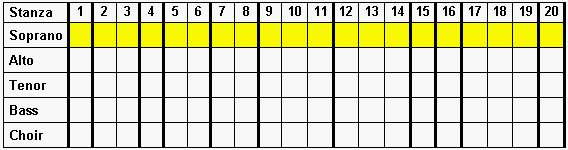
Soprano, strings
Length
38.59 minutes
Particulars
This Stabat Mater is divided into 11 parts, varying from 1 to 3 stanzas, with an opera-like sound. The "arias" contain a lot of coloratura. The cello player Boccherini clearly could not refrain from using a solo cello as accompaniment to some of the stanzas.
Textual variations
The text according to the "Analecta" is used, with the exception of line 2 of stanza 16: not "Passionis eius sortem" but "Passionis fac consortem"
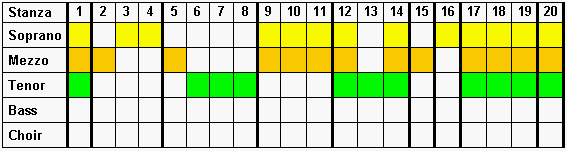
Colour bar
Information about the recording
CD1:
Erato 2292-45425-2: Boccherini, Stabat Mater
More info:
Recorded at the Palazzo Giusti, Padoue, November 1988 I bought this CD in a record shop in the Netherlands, 1998
Orchestra:
I Solisti Veneti
Conductor:
Claudio Scimone
Soloists:
Cecilia Gasdia, soprano
Other works:
Recitativo e Aria "Ah no! Son io che parlo" Aria da Concerto "Care luci"
Code:
1998 (BOC 01)
CD2:
HAUD 130305: Boccherini and Pärt KRO – Stabat Mater Foundation
More info:
Live registration of the performance in Oirschot in March 2005