Antonín Dvořák (1841-1904) was born in Nelahozeves, Czechia. As the son of a village butcher he started his musical education rather late, but still, only just over thirty years of age Dvořák already was a world famous composer. Especially his Slavonic Dances contributed to his fame. He is regarded as a Czechian composer par excellence and as a representative of the Viennese School and the Romantic movement. After the death of his daughter Josefa in 1875, Dvořák composed the initial version of his Stabat Mater for four soloists, choir, and piano. He then set the work aside without orchestrating it. Soon after this, he lost two more children in 1877. At this point he returned to the manuscript abandoned the previous year. Nonetheless his Stabat Mater ends in a major key, as if in expression of hope. The style is a mixture of symphonic poem, German oratorio and Italian opera, but still it is written from the heart. A more extended description of Dvořák’s life and his Stabat Mater can be found in a lecture on Theology in Music by Rev.P.Okke Postma, which he kindly sent to me.
About the Stabat Mater
Date
1877
Performers
Soprano, alto, tenor, bass, choir and orchestra
Length
CD 1: 86.22 minutes, CD 2: 90.58 minutes CD 3: 82.46 minutes
Particulars
The longest Stabat Mater that I know of. The composition is divided into 10 sections. The text is full of repetitions, in words, sentences or complete stanzas, that are sung separately, together or mixed with other stanzas. The substance of Dvořák's setting is not the treatment of individual words or ideas in the text, but rather the expression of the poem's basic moods and visions.
Textual variations
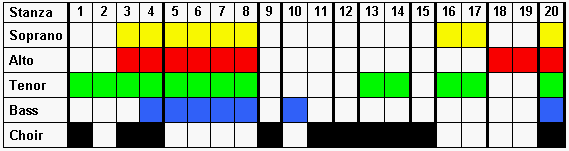
The "Analecta"-text is used, with only one small variation: - Stanza 4, line 2: not "Et tremebat cum videbat" but "Piam Mater, dum videbat"
Colour bar
Information about the recording
CD1:
Deutsche Grammophon 453 025-2 (2 CDs): Dvořák, Stabat Mater * Legends
More info:
Two major works of Dvořák. Recorded at the Hercules-Saal, München, in September 1976
Orchestra:
Symphonie-Orchester des Bayerischen Rundfunks
Choir:
Chor des Bayerischen Rundfunks
Conductor:
Rafael Kubelik
Soloists:
Edith Mathis, soprano Anna Reynolds, alto Wieslaw Ochman, tenor John Shirley-Quirk, bass
Other works:
Antonin Dvořák: Legends
Code:
Unknown (DVO 01)
CD2:
STM 981 (2 CD's): Dvořák, Stabat Mater
More info:
The recording of the first concert organized by the Dutch Stabat Mater Foundation. Recorded at the Provinciehuis, 's-Hertogenbosch, in March 1998.
Orchestra:
Orchestre Philharmonia de Paris
Choir:
Choeur Symphonique de Paris
Conductor:
Xavier Ricour
Soloists:
Marie-Paule Dotti, soprano Christine Labadens, mezzo-soprano Patrick Garayt, tenor Jean Louis Serre, bariton
Other works:
none
Code:
1999 (DVO 02)
CD3:
KRO ES47.407 (2 CD's): Dvořák, Stabat Mater
More info:
The recording of the fourth concert organized by the Dutch Stabat Mater Foundation. Recorded at the Sint Petrus Church, Oirschot, in March 2001.
Orchestra:
Het Brabants Orkest
Choir:
Brabant Koor
Conductor:
Jan Willem de Vriend
Soloists:
Eva-Maria Westbroek, soprano Wilke te Brummelstroete, mezzo-soprano Frank van Aken, tenor Jaco Huypen, bariton